
Gas Fireplaces Australia: The Complete Buying Guide
Types, running costs, star ratings, flue requirements and the best gas log fires compared, written by a licensed gas fitting business that has sold, installed and serviced gas fireplaces across Australia for 30+ years.
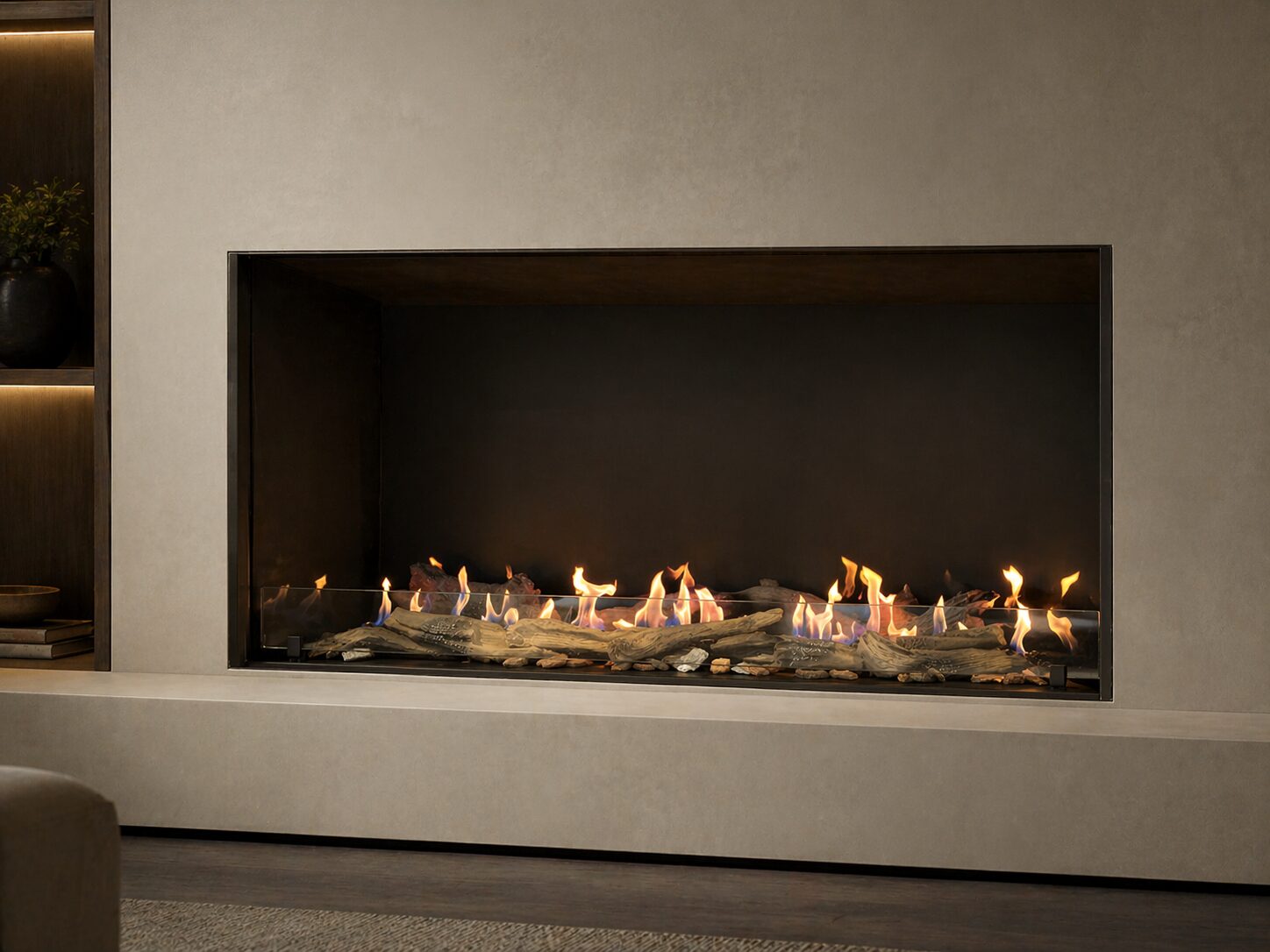
What is a gas fireplace? A gas fireplace is a heating appliance that burns natural gas or LPG behind a glass front or open face to produce a real flame over ceramic logs, pebbles or crystals, typically delivering 4 to 8 kW of heat. In Australia, gas fireplaces must be installed by a licensed gas fitter and most modern units use a balanced flue that vents directly through a wall or roof, so no traditional chimney is needed. Installed prices in Australia typically range from around $3,000 for a compact insert to $10,000+ for large designer linear fires.
- Gas fireplaces deliver 4 to 8+ kW of heat, enough to warm large open-plan living areas that electric fireplaces cannot.
- Running costs are roughly 60 cents to $1.10 per hour on natural gas at typical Victorian tariffs, depending on the burner setting and the unit's star rating.
- Balanced flue technology means most modern gas fires vent through a wall or roof; no chimney is required, and the room-sealed firebox keeps indoor air quality high.
- All gas fireplace installation in Australia is licensed gas fitting work by law, and a Certificate of Compliance must be issued.
- O'Briens sells gas log fires from Australia's leading brands with in-house licensed gas fitters (VBA #44800), so the fireplace, gas line, flue and compliance paperwork come from one local team.
How Do Gas Fireplaces Work?
A modern gas log fire is a sealed, engineered heating system, not just a burner behind glass. Understanding the technology explains why installed prices vary so much.
Inside the firebox, a gas burner produces a real flame that rises through a ceramic log set, pebbles or crystals designed to glow like embers. A heat exchanger captures the combustion heat, and in most units a fan pushes that warmth into the room while combustion gases exit through the flue. Ignition is electronic: press a button on the remote or wall control and the fire is running at full flame within seconds, with a thermostat holding the room at your chosen temperature.
The most important piece of modern gas fire engineering is the balanced flue (also called direct vent). It is a sealed twin-pipe system: one pipe draws combustion air from outside, the other expels exhaust outside, and the firebox is completely sealed from your room. That means no chimney, no draughts, no combustion products entering your living space, and far higher efficiency than the open gas fires of decades past. It is also why balanced flue fires can be installed on almost any external wall, or vented vertically through the roof for internal walls.
Gas fires run on either natural gas (mains connection) or LPG (bottles), and most models are available in both configurations, which matters across regional Australia where mains gas is not always available.
Why Gas Is Still Australia's Favourite Fireplace
Real Flame, Real Heat
A genuine dancing flame with 4 to 8+ kW of output. Gas is the only fireplace type that combines authentic fire with enough power to heat large open-plan spaces.
Instant, Set-and-Forget Control
Full flame in seconds from a remote, wall switch or app, with thermostat control that holds the room at temperature. No kindling, no waiting, no tending.
No Mess, No Wood Pile
No ash, no smoke, no chopping and no storing firewood. The log set never burns down and the glass wipes clean once a season.
Efficient Zone Heating
Modern balanced flue fires reach energy efficiency ratings of up to 5+ stars, converting far more of the gas you pay for into heat in the room than old open fires ever did.
Design Freedom
Landscape linear fires over a metre wide, classic log fires for period homes, double-sided room dividers and inserts that revive dead masonry fireplaces.
Adds Real Value
An installed gas log fire is a permanent feature buyers notice. It is one of the few heating upgrades that improves both comfort and resale appeal.
Types of Gas Fireplaces in Australia
Four main formats cover almost every Australian home. The right one depends on whether you are building, renovating, or reviving an old fireplace.
Inbuilt / Linear Gas Fireplaces
Built into a framed wall or existing structure with a wide landscape viewing window, from around 750 mm to over 1.5 m. The format behind almost every designer feature wall in Australia, and the strongest choice for new builds and major renovations.
Shop inbuilt gas fires →Gas Fireplace Inserts
Designed to slide into an existing masonry fireplace or chimney cavity, converting a draughty open fire into a sealed, efficient gas heater while keeping the original hearth as the feature. The fastest way to bring a period fireplace back to life.
Shop gas inserts →Freestanding Gas Log Fires
The classic wood-stove silhouette on a plinth or legs, flued through the wall or roof behind it. Ideal where there is no cavity to build into, and a favourite in farmhouses and living rooms across regional Victoria.
Shop freestanding gas fires →Double-Sided & See-Through Gas Fires
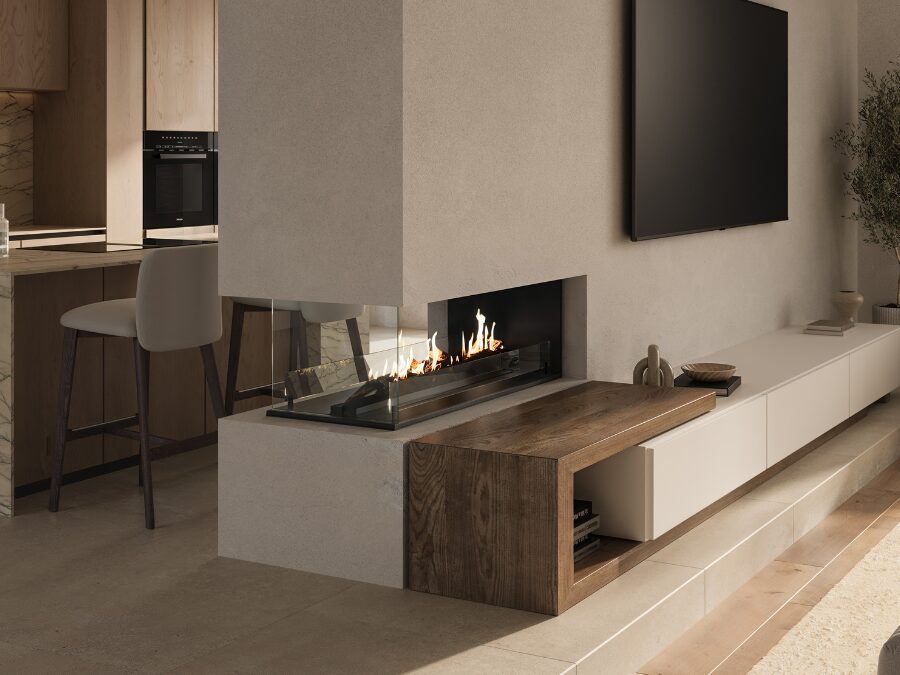
One firebox visible from two rooms, or from inside and an alfresco area. A dramatic architectural feature that also heats both spaces at once. Ask our team which double-sided models suit your floor plan.
Ask about double-sided fires →The O'Briens Gas Fireplace Range
We stock and install gas log fires from the brands that dominate the Australian market, and every unit we sell can be installed, flued and certified by our own licensed gas fitters. Prices correct as at July 2026.
Heat & Glo
The inventors of balanced flue technology, now the industry standard. Their IntelliFire ignition system and premium linear fires like the Mezzo and SLR-X series set the benchmark for luxury Australian installs.
Shop Heat & Glo →Rinnai
Australia's most recognised gas heating name. Rinnai gas log fires pair ember bed technology with high-performance heat exchangers, with efficiency ratings up to 5.5 stars on flagship models.
Shop Rinnai →Jindara & More
Alongside Heat & Glo and Rinnai we carry trusted names including Jindara and Blaze, covering everything from compact inserts to wide landscape fires, in natural gas and LPG.
Browse the full range →How Much Does a Gas Fireplace Cost to Run in Australia?
Gas fire running costs come down to two numbers: the unit's gas input (measured in megajoules per hour, MJ/h) and your gas tariff (cents per megajoule). At typical Victorian natural gas tariffs of around 3 to 4.5 cents per MJ:
| Setting | Typical gas input | Approx. cost per hour (natural gas) |
|---|---|---|
| Low flame / thermostat maintaining | 10 to 15 MJ/h | 30 to 65 cents |
| Medium | 18 to 22 MJ/h | 55 to 95 cents |
| High flame | 25 to 30 MJ/h | 75 cents to $1.35 |
Three factors pull real-world costs below the high-flame figure. First, thermostat control means the fire spends most of the evening on low once the room is warm. Second, energy star ratings matter: a 5-star balanced flue fire converts significantly more of each megajoule into room heat than a 3-star unit, so the efficient fire costs less to deliver the same warmth. Third, zone heating one living area always costs less than running whole-home heating for the same comfort. LPG costs more per megajoule than natural gas, so bottled-gas households should weight star ratings even more heavily when choosing a model.
Compared with alternatives: gas sits between wood (cheapest if you have firewood access, most work) and electric (cheapest to buy and install, least heat). For most Australian families wanting real flame plus serious heat with zero effort, gas remains the sweet spot.
What Size Gas Fireplace Do You Need?
Gas fires are sized by heat output in kilowatts. As a guide for typical Australian ceiling heights and insulation:
| Area to heat | Recommended output | Typical format |
|---|---|---|
| Up to 40 m² (living room) | 3.5 to 5 kW | Compact insert or small inbuilt |
| 40 to 80 m² (large living / kitchen-living) | 5 to 7 kW | Mid-size inbuilt or freestanding |
| 80 to 120 m² (open plan) | 7 to 9+ kW | Large linear fire with fan boost |
Undersizing is the common mistake: a fire running flat-out all night to keep up costs more and wears faster than a correctly sized unit cruising on medium. High ceilings, big glazing areas and poor insulation all push you up a size. In North East Victoria's cold winters we usually recommend sizing generously; tell us your room dimensions and we will match models to the space at no charge.
Gas vs Wood vs Electric Fireplaces: An Honest Comparison
We sell all three, plus bioethanol, so we have no reason to oversell gas. Here is how they genuinely stack up for Australian homes.
| Factor | Gas | Wood | Electric |
|---|---|---|---|
| Heat output | 4 to 8+ kW, thermostat controlled | Highest, whole-home capable | 1.5 to 2 kW zone heating |
| Flame | Real flame, instant | Real fire, unbeatable ambience | LED flame effect |
| Effort | Push a button | Source, store, light, tend, clean | Push a button |
| Installation | Licensed gas fitter + balanced flue | Flue kit, hearth, clearances | Plug in or simple hardwire |
| Running cost | ~60c to $1.10/hr typical | Lowest with cheap firewood access | ~30 to 70c/hr on heat mode |
| Maintenance | Service every 2 years | Annual flue clean, ash removal | Essentially none |
| Suits apartments/rentals | Rarely | No | Yes |
| Typical entry price | From ~$3,000 installed | From ~$3,900 with flue kit | From $820 |
The short version: choose wood for maximum heat and the ritual of a real fire on a rural block, electric for installation flexibility and rentals, and gas when you want a genuine flame with serious heat output and none of the work. If you are within reach of Wangaratta, our showroom displays all three types running so you can compare them side by side before deciding.
Installation: Why Buying From a Licensed Gas Fitter Matters
Here is the part many fireplace showrooms gloss over: in Australia, every part of a gas fireplace installation is licensed gas fitting work by law. That covers running or extending the gas line, connecting the appliance, installing the balanced flue, commissioning the burner and issuing the Certificate of Compliance that proves the work was done safely and to Australian standards. Using anyone unlicensed is illegal, voids the appliance warranty, and creates a genuine safety risk.
Most retailers sell you the fire, then hand you off to a third-party installer they have never met. O'Briens is different for one simple reason: we are the gas fitters.
- Licensed gas fitters on staff (VBA #44800), not subcontracted strangers
- Certificate of Compliance issued on every applicable job
- Gas line, flue penetration, framing advice and commissioning handled by one team
- Natural gas and LPG conversions done correctly
- In-house electricians (REC #28927) for the fan and ignition power circuit
- Local install service across Wangaratta and North East Victoria, with Australia-wide product delivery
Buying the fireplace and the compliant installation from the same 30-year local business means one point of accountability for the appliance, the gas work and the warranty. Read more about our gas fitting services.
Servicing and Gas Safety
A gas log fire should be professionally serviced every two years. A service covers burner cleaning and adjustment, log set repositioning, flue inspection, seal checks and, critically, a carbon monoxide spillage test. Regular servicing keeps efficiency high, protects the warranty and catches faults before they become dangerous.
Between services, the golden rules are simple: keep the area around the fire clear, never modify the log set layout yourself (log placement is engineered for correct flame patterns), and if you ever smell gas, turn the appliance off, ventilate the room and call a licensed gas fitter immediately. Our team services all the gas fireplace brands we sell, and most others, across North East Victoria.
Your Gas Fireplace Buying Checklist
- Confirm natural gas availability or plan for LPG bottles
- Match heat output (kW) to your room size, and size generously in cold climates
- Check the energy star rating; higher stars mean lower running costs for the same heat
- Decide inbuilt, insert, freestanding or double-sided based on your wall and floor plan
- Plan the flue route: external wall for horizontal, roof for internal walls
- Choose your media: logs for traditional, pebbles or crystals for modern
- Confirm TV and mantel clearances for the specific model
- Get the installation quoted by a licensed gas fitter before committing to a unit
- Confirm a Certificate of Compliance will be issued on completion
Why buy your gas fireplace from O'Briens?
We are a family-owned Wangaratta business that has sold, installed and serviced gas fireplaces for more than 30 years, with licensed gas fitters, plumbers and electricians on our own team and a showroom where the fires are running.
Honest brand comparisons, Australia-wide product delivery, local installation across North East Victoria, and a Certificate of Compliance on every job.
Gas Fireplace FAQs
How much does a gas fireplace cost in Australia?
Expect around $3,000 to $6,000 installed for a quality compact insert or mid-size gas log fire, and $6,000 to $10,000+ for large designer linear fires, depending on the model, flue route and gas line work required. The appliance is usually two thirds of the cost and installation the remainder. We quote the full installed price upfront so there are no surprises.
How much does a gas fireplace cost to run?
At typical Victorian natural gas tariffs of 3 to 4.5 cents per megajoule, a gas log fire costs roughly 30 to 65 cents per hour on low and 75 cents to $1.35 per hour on high flame. Thermostat control keeps most evenings closer to the low figure, and higher star-rated units deliver the same heat for less gas.
Do gas fireplaces need a chimney?
No. Modern gas fireplaces use a balanced flue, a sealed twin pipe that vents horizontally through an external wall or vertically through the roof. Existing chimneys can be used as the flue route for insert models, which is how old open fireplaces are converted to gas.
Do I need a licensed gas fitter to install a gas fireplace?
Yes, by law. All gas appliance installation in Australia, including the gas line, connection, flue and commissioning, must be performed by a licensed gas fitter, who must issue a Certificate of Compliance. O'Briens' installers are licensed gas fitters (VBA #44800), so the appliance and the compliant installation come from one team.
Are gas log fires efficient?
Modern balanced flue gas fires are dramatically more efficient than old open gas fires, with energy ratings up to 5+ stars on leading models. The sealed room-sealed firebox stops heated room air escaping up a chimney, and the heat exchanger and fan deliver most of the combustion heat into the room.
Can a gas fireplace heat a whole house?
A large 7 to 9 kW gas log fire will comfortably heat an open-plan area up to around 120 square metres, which for many single-level homes is most of the living space. For whole-home heating including bedrooms, pair the fireplace with ducted heating or split systems and use the fire as your main living-area heat.
Natural gas or LPG: which is better for a gas fireplace?
If mains natural gas is available at your home, it is usually cheaper per megajoule and needs no bottle management. LPG is the answer where mains gas is unavailable, common across regional Australia, and most models are offered in both configurations. We supply and convert for both.
How often should a gas fireplace be serviced?
Every two years by a licensed gas fitter. A proper service includes burner cleaning, log set checks, flue inspection and a carbon monoxide spillage test, which keeps the fire safe, efficient and under warranty.
Can I put a TV above a gas fireplace?
Often yes, but it depends on the model. Many modern linear gas fires offer heat deflection options or cool wall technology designed for TVs above. Clearances are model-specific and non-negotiable for safety and warranty, so check the specification or ask our team before finalising your wall design.
Do you deliver gas fireplaces Australia-wide?
Yes. We ship gas fireplaces across Australia, with faster delivery throughout North East Victoria and the Border region, and we install locally across the Wangaratta region. Interstate customers should engage a licensed gas fitter in their area for installation; the Certificate of Compliance requirement applies everywhere in Australia.
Ready to find your gas fireplace?
Compare Australia's leading gas log fire brands, get an honest installed price, and have the whole job done by the licensed local team that has been doing it for 30+ years.
